Smart Business
30.07.2025
|
Reading time7 min
What Design Thinking is and how it helps companies innovate
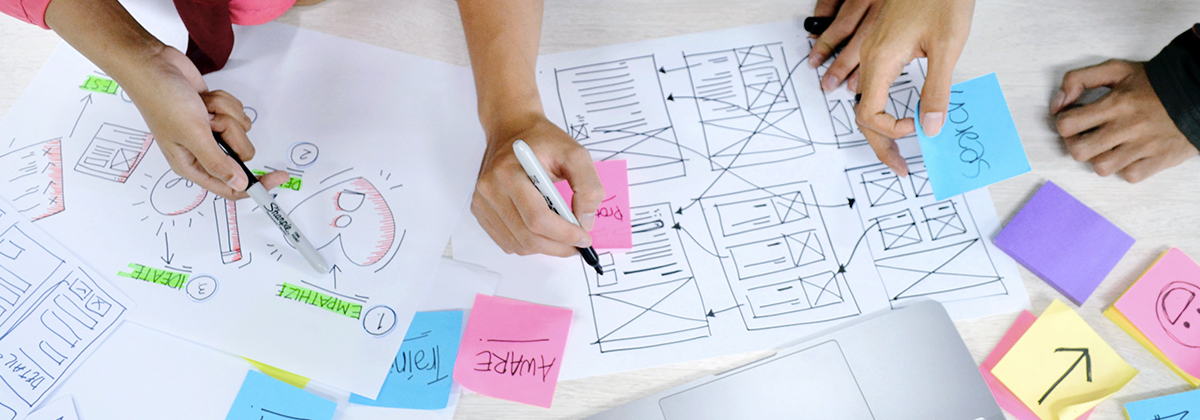
Thinking what no one has thought of yet and solving problems no one has ever managed to solve, thanks to creative thinking.

In this article you’ll discover:
The design thinking methodology increases companies’ ability to make effective and profitable decisions by leveraging the involvement of various internal and external stakeholders. It does so by enabling teams to develop creative thinking through highly cohesive and determined groups, in which the vision of problems goes hand in hand with the identification of potential innovative solutions.
Companies have understood the need to question themselves in order to move beyond operating patterns that are now outdated and, above all, ineffective in business terms. They must also develop a culture of continuous learning, experimenting and working with people who bring new skills and ideas.
This means learning an open innovation design method that helps adopt a different approach, develop a bias toward action and consider the possibility of failure, because that is precisely where the greatest lessons emerge.
What are the benefits of design thinking?
One of the main benefits is that it provides a sound method for making crucial, strategic decisions, drastically reducing the risks associated with them. It also promotes an attitude of listening, collaboration and teamwork, and makes it easier to focus on the needs of people, companies and customers. This methodology improves decision-making, creates a culture of innovation, reduces costs and fosters a positive, proactive environment.
What are the fields of application of design thinking?
Design thinking can be applied to all kinds of problems, whether they concern strategy, organization or the development of new products and services; it delivers the best results for both minor and complex problems.
It starts with people. Behaviors are observed and needs are intuited. It is a “user-centric” method that starts from the consumer/customer to capture value and transfer it to the product, and this is how a business model that truly works is built.
Who is it for?
Design thinking is aimed at anyone who wants to improve their performance, competitiveness and effectiveness. In particular, it is suited to companies that intend to put innovation at the heart of their strategy and achieve tangible results. Design thinking applies equally to any type of organization: from startups to large multinationals to non-profits. It is a method, and as such it can be applied successfully by a few people or by many, involving different business functions and including the active contribution of suppliers, customers, partners, etc.
What is the goal? And what are the principles of design thinking?
The goal of design thinking is to identify an innovative solution to a problem that meets 3 fundamental criteria:
● Desirability: customer centricity, putting yourself in their shoes.
● Feasibility: identifying themes and patterns through observation and analysis to assess consumption/purchasing behaviors.
● Profitability or economic sustainability: defining the winning solution in terms of sustainability and profitability.
This methodology is built by placing the individual at the center. Before starting any session, it is important to clearly understand and embrace the principles of design thinking, focusing on users’ needs, the potential of the work team and the spirit of creativity.
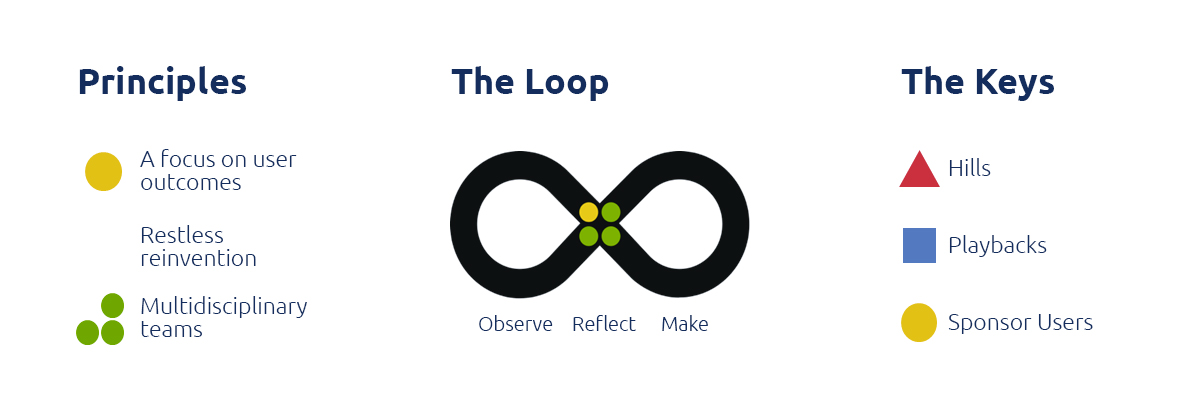
CUSTOMER FOCUS: Design thinking stems from the desire to look at users’ needs and help them address them. That is why the role the end user plays in the innovation process is fundamental. The focus is on listening and on understanding their needs. Success is then measured by the extent to which the customer’s needs are met.
DIVERSE TEAMS: diverse teams generate many more ideas than a homogeneous team, thus increasing the chances of finding the right solution. Different skills contribute to generating multiple ideas in order to identify the best one, centered on the customer’s needs.
CONTINUOUS EXPERIMENTATION: this model is the so-called Loop, a continuous cycle of observation, reflection and making. You can proceed in whatever order you prefer, carrying out all the iterations needed. Abstract ideas are given concrete form by continuously exploring possibilities in order to arrive at a feasible hypothesis that can always be questioned and improved.
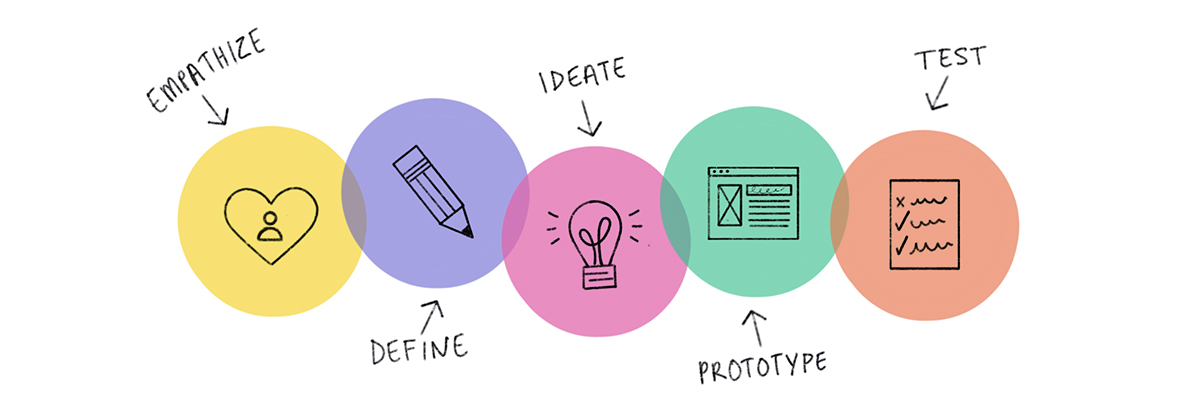
What are the phases of design thinking
1. Empathize: getting to know the user and understanding their needs, wants and goals. People are observed and analyzed to understand their needs and emotional behaviors. In this phase, the aim is to gather as much real information about the user as possible, setting aside judgments and expectations. This first phase requires attention to detail to define the so-called “personas“, who will then be the focal point of the entire session and from whom ideas and solutions will originate and develop. Knowing the user is essential, and overlooking details could compromise the success of the session.
● Tools: customized research, direct contact with the customer.
● Goal: gather information, input and details in order to bring out opportunities for innovation.
2. Define the problem: identifying the definition of the user’s problem. It is necessary to define the difficulties and obstacles users encounter and narrow down the problem the team is called upon to solve. The problem is analyzed by putting oneself in the user’s shoes once their needs have been gathered and analyzed.
● Tools: personas, customer journey map. Identify the key characteristics of the “personas”, focusing on their purchasing behavior based on context (external factors, needs, values and goals that influence our persona’s experience), emotional state (noting feelings and emotions at the various stages), actions (what the persona concretely wants to do) and key factors (touchpoints and new opportunities).
● Goal: translate the input received, identifying the foundation from which to develop an innovative solution.
3. Ideate: at this stage, there is solid knowledge of the users and a clear understanding of the problem or problems. This is the point at which solution design begins. Here, participants’ creativity and ideation skills are needed. It is necessary and useful to bring the team together, even several times, in order to gather and compare as many ideas as possible. Various ideation techniques can be used, such as brainstorming and mind-mapping. Only at the end will the best ideas be identified.
● Tools: idea generation, mind-mapping, post-it notes.
● Goal: develop concepts, potential ideas and solutions and define them through continuous testing with users.
4. Prototype: this is where ideas are turned into tangible products. It is essentially a scaled-down version of the product that incorporates the potential solutions identified in the previous phases. Any problems and flaws emerge and become evident here, and at this point the designed solutions can be confirmed, improved, redesigned or rejected.
● Tools: Scenario and Prototyping.
● Goal: move forward in defining strategies, roadmaps and implementation activities.
5. Test: in this phase, the solutions can be tested on users, which does not mean that this phase marks the end of the process. Feedback from testing may bring to light elements that require redefining the analysis of the original problem or developing new ideas that had not been considered before.
● Tools: tailored to the business.
● Goals: put the solutions to the test.
What are the results?
The design thinking approach makes it possible to conceive and develop innovative solutions by gaining a thorough understanding of who the key players are, developing ideas shared by all colleagues, and reducing risks by adopting solutions that create value for the customer and the market.
Through this approach, companies have the opportunity to broaden their competitive reach. Today, design thinking makes it possible to align commercial and business needs with the technical needs of Innovation and IT. It therefore provides innovative solutions that meet users’ needs, achieving results quickly and at scale.
To find out how Intesa is using design thinking to solve users’ problems and improve customer experiences, contact our team.
Discover solutions for your company’s digital transformation:
Browse categories