Elliptic curve cryptography: what it is and why Intesa is changing its Certification Authority
Regulations
11.11.2026
|
Reading time: 8 min
Elliptic curve cryptography” refers to a family of public-key cryptography techniques, all based on elliptic curves. It therefore includes different algorithms, each with a specific task. Elliptic curve cryptography provides the same level of protection as traditional algorithms while using much shorter keys, which is why it is adopted in many areas of cybersecurity. In this article we explain, starting from the basics, how it works, how elliptic curve cryptography differs from the RSA algorithm and why Intesa has chosen it for its new Certification Authority.
The basics: keys, digital signatures and Certification Authorities
Digital signatures are based on public-key cryptography. Each signatory has two linked keys: a secret private key, used to sign, and a public key, which anyone can know and which is used to verify the signature. It is like a seal kept in a safe and a sample of its impression that anyone can consult to compare it.
What remains to be established is who a public key belongs to. This is the job of the Certification Authority (CA), the body that issues digital certificates: electronic documents that “contain” the public key and link it to the identity of a person or an organisation. The CA in turn signs each certificate and guarantees its authenticity, like the office that issues a passport. Whoever receives the document verifies the signature with dedicated verification software, using the public key contained in the certificate, and checks that the certificate was signed by a recognised CA, that is one included in the Trusted List, and that it has not expired or been revoked.
Qualified Trust Service Providers (QTSPs), with their qualified services and the certificates of their respective CAs, are listed in official national registers called Trusted Lists, which allow verification tools to recognise qualified certificates and electronic signatures. The CA also uses cryptography to sign certificates: the algorithm it chooses affects the robustness of the entire chain of trust.
What key length means
A cryptographic key is, essentially, a very large number. Its length is measured in bits, that is binary digits, which can only be 0 or 1. The longer the key, the more possible combinations there are and the harder it is to guess, as with a combination lock: with 3 digits there are a thousand combinations, with 6 there are a million. In the case of bits, each additional bit doubles the combinations.
Longer keys offer more protection, but they also require more computation. How long a key must be to be secure, however, depends on the cryptographic system used: some need very long keys, others achieve the same protection with much shorter keys. This is precisely the difference between RSA and elliptic curves, which we look at in the next sections.
RSA, the most widespread cryptography so far
RSA, an acronym formed from the initials of its inventors Ron Rivest, Adi Shamir and Leonard Adleman, has been the most widely used public-key algorithm of recent decades. It is based on multiplying two very large prime numbers: multiplying them is immediate, whereas working back to the two original numbers knowing only the result takes, with today’s computers, an enormous amount of time.
The limit of RSA is key length. As computing power increases, and factorisation techniques improve, keys must become longer and longer to maintain the same protection, and calculations and signatures become heavier. Moreover, the growth is not proportional: to double the security level an RSA key would have to become about five times longer (from 3072 to 15360 bits), whereas an elliptic curve key only needs to double in length (from 256 to about 512 bits). A 3072-bit RSA key, a length in line with the recommendations of ENISA, the European Union Agency for Cybersecurity, is a number of 3072 binary digits: written in decimal notation, it would have about 925 digits.
How elliptic curve cryptography works
Compared with RSA, elliptic curve cryptography is based on a different mathematical problem. An elliptic curve is a line with a particular shape, described by an equation. A geometric rule applies to its points, based on straight lines that cut through the curve, which makes it possible to move from one point to another. You start from a point on the curve known to everyone and apply this rule a number of times that only the owner knows: each step leads to a new, seemingly random point. The number of steps is the private key, the end point is the public key. In practice, the calculations are not performed on a drawn curve but on a finite set of numbers, and the number of steps is enormous: thanks to mathematical shortcuts, such as successive doublings, the end point is nevertheless obtained in a few moments.
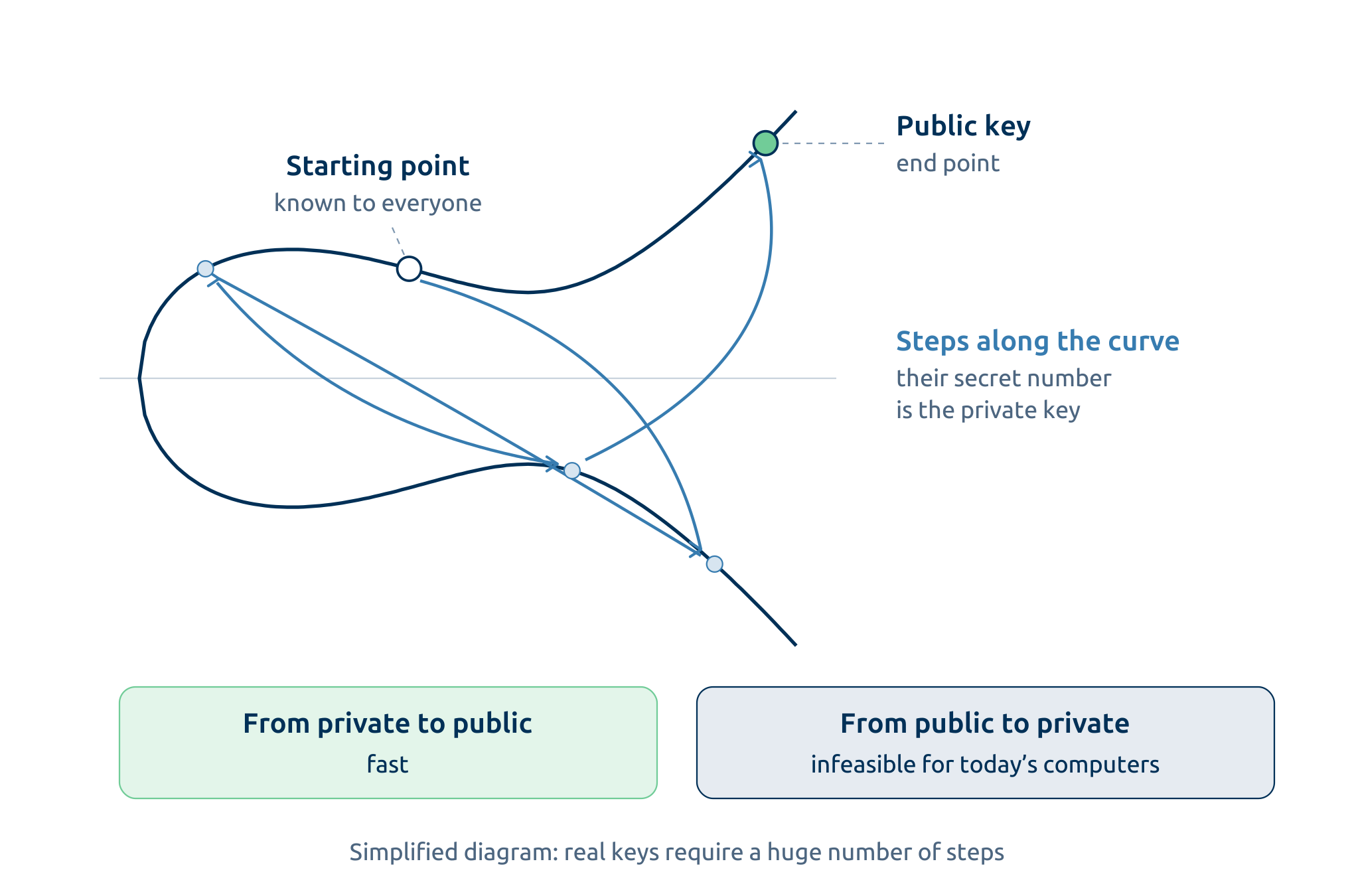
Deriving the public key from the private key is quick; working back to the private key from the public key is, for today’s computers, a prohibitive task. It is like mixing two colours of paint: combining them is immediate, separating them again is not. Signature algorithms such as ECDSA (Elliptic Curve Digital Signature Algorithm) use this mechanism to sign and verify.
Why elliptic curves are more efficient
The problem on which elliptic curves are based remains hard even with numbers much smaller than those needed by RSA. For this reason, for the same level of security, much shorter keys are enough: a 256-bit elliptic curve key offers protection comparable to that of a 3072-bit RSA key.
Shorter keys mean faster signing operations, more compact signatures and certificates and fewer resources used, a concrete advantage for anyone managing large volumes of signatures. Signature verification, on the other hand, remains very fast with RSA: the gain from elliptic curves mainly benefits the signer. Elliptic curve cryptography is also a mature standard, studied for decades and adopted in many areas of cybersecurity.
Elliptic curves and quantum computers
Once they are powerful enough, quantum computers could challenge the public-key algorithms in use today, including RSA and elliptic curves. It is not known when this will happen: that moment is called “Q-Day”. To prepare, the Member States of the European Union have agreed on a common roadmap: start the transition by the end of 2026, protect the highest-risk systems by 2030 and complete the transition, as far as possible, by 2035.
Elliptic curve cryptography is therefore not the definitive answer to quantum computing, but an intermediate step: it updates infrastructures with a more modern and efficient technology, and makes it possible to practise, on a real CA, the ability to change algorithm (crypto-agility), which will be needed for the next step: the adoption of post-quantum algorithms, designed to withstand quantum attacks as well.
The Intesa case: a new elliptic curve Certification Authority
Until now, Intesa’s CA has used keys based on the RSA algorithm, the most widespread public-key algorithm of recent decades.
By 9 January 2027 it will be replaced by a new CA based on elliptic curve algorithms (P-384 curve, with 384-bit keys: a higher level of protection than RSA 3072), included since 10 July 2026 in the Italian Trusted List managed by AgID (Agenzia per l’Italia Digitale, the Agency for Digital Italy) and therefore also accessible through the European List of Trusted Lists published by the European Commission.
Intesa has therefore chosen to align early with the latest cryptographic mechanisms agreed at European level, collected in the document ECCG Agreed Cryptographic Mechanisms, drawn up by the European Cybersecurity Certification Group (ECCG) and published by ENISA. Moving early makes it possible to proceed step by step and to give the entire supply chain, from software producers to service users, time to check their systems.
In an initial phase, however, elliptic curves will concern only the CA, not the new signature and seal certificates, which will switch to 3072-bit RSA keys. The chain of trust usually contains two key pairs, each with its own algorithm: the CA’s, which signs certificates and is moving to elliptic curves, and the holder’s, which signs documents. When someone receives a signed document, the verification tool performs two checks: with the holder’s RSA public key, contained in the certificate, it verifies the signature on the document; with the CA’s elliptic curve public key it verifies that the certificate is authentic. As with a passport, the holder’s signature and the stamp of the issuing office are different marks, and the document is valid because both are there: elliptic curves change the stamp, not the signature.
Frequently Asked Questions
What is elliptic curve cryptography?
Are elliptic curves more secure than RSA?
Does elliptic curve cryptography protect against quantum computers?
What does a 3072-bit key mean?
Do I need to replace the Intesa certificates I already have?
Do I need to update the systems that verify signatures?
Discover the solutions for your company’s digital transformation:
Browse categories
You might be interested in
Regulations
25.09.2026
What changes with the REM (or European PEC) in 5 points
PEC is destined to disappear to make way for REM, a Qualified Electronic Delivery Service (SERCQ) as required by the European eIDAS regulation. Here is…

Regulations
16.09.2026
eIDAS 2.0: digital identity as a competitive advantage for financial institutions
For financial institutions, eIDAS 2.0 and the EU Digital Identity Wallet offer a concrete opportunity: transforming digital identity from a compliance requirement into a competitive…

Regulations
06.09.2026
eIDAS 2.0 implementing acts: where we stand and what changes for businesses
Over 30 implementing acts adopted, the three July 2026 updates already in force and just over two months to the first major deadline. The eIDAS…